Short Answer – Pharmacy clinic vs. resort doctor vs. ER in Mexico
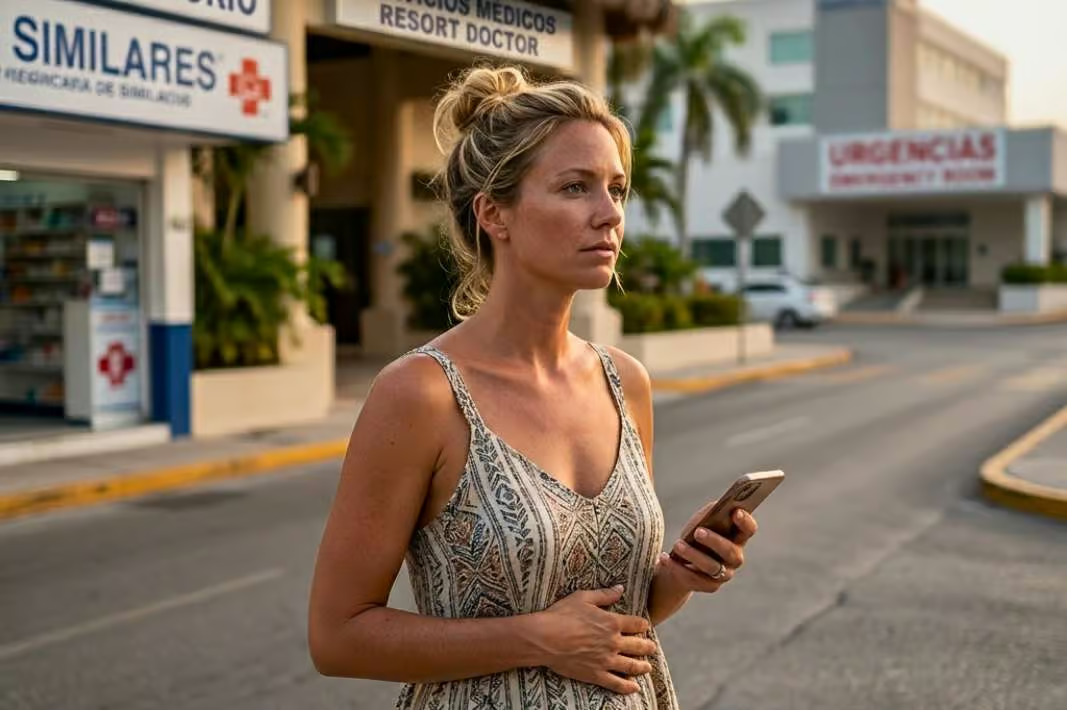
When you get sick in Mexico, the right option depends on how serious your symptoms are. Pharmacy clinics like Farmacia Similares handle common conditions – traveler’s diarrhea, UTIs, minor infections – for under $5 USD. Resort doctors offer convenience at a higher cost for mild to moderate symptoms when you can’t leave your hotel. Private hospital ERs like Amerimed or Hospiten are for genuine emergencies: chest pain, severe dehydration, high fever, or suspected fractures.
Not sure which option fits your symptoms? Use our emergency triage tool to find out in 60 seconds.
Comparing Your Options at a Glance
| Feature | Pharmacy Clinic | Resort Doctor | Hospital ER |
| Typical Cost | $3 to $5 USD consultation, plus medications | $100 to $300 USD per visit | $200 to $1,500+ USD depending on tests and treatment |
| Wait Time | 15 to 45 minutes | Same day, often within 1 to 2 hours | 30 minutes to several hours |
| English Spoken? | Rarely in non-tourist areas, sometimes in resort zones | Almost always | Yes at private hospitals like Amerimed and Hospiten |
| Hours | Most open 8 AM to 10 PM daily, some 24 hours | By appointment through hotel front desk | 24/7 |
| Common in Mexico Because… | Over 9,600 Farmacia Similares locations alone; pharmacy clinics handle roughly 136 million appointments per year nationwide | All-inclusive resorts and large hotels contract doctors to keep guests on property | Private hospitals in tourist corridors are built specifically to serve international visitors |
| Best Use / Considerations | Best For: Mild infections, stomach issues, minor skin problems, prescription refills. Limitations: No lab work, no imaging, no IV fluids, limited English | Best For: Convenience when you can’t leave the resort, mild to moderate symptoms. Limitations: Higher cost for basic care, limited equipment, no continuity after checkout | Best For: Trauma, severe dehydration, chest pain, high fevers, breathing difficulty, broken bones. Limitations: Expensive for conditions that don’t require emergency-level resources |
Understanding Pharmacy Clinics
Pharmacy clinics (or consultorios, as they’re locally known) are small doctor’s offices right inside pharmacies, and they’re the main way most people in Mexico access everyday healthcare. You’ll see a general practitioner in a compact exam room, and if you need medication, the pharmacy counter is right next door. The entire visit usually takes under 30 minutes.
Why Tourists Should Know About Them
- They’re everywhere. Farmacia Similares has over 9,600 locations across Mexico, and Farmacia del Ahorro and Farmacia Benavides run the same setup. In pretty much any town tourists visit, you’ll be within a few blocks of one.
- They’re genuinely inexpensive. A consultation at Farmacia Similares currently runs 50 to 80 pesos — about $3 to $5 USD. Medications, particularly generics, are frequently much cheaper than what you’d pay in the US or Canada.
- They treat the conditions tourists commonly get. Traveler’s diarrhea, mild UTIs, sinus and ear infections, sunburn reactions, and minor skin rashes are all within their scope. The doctor can prescribe antibiotics, anti-nausea medication, or pain relief on the spot.
- No appointment needed. You go in, take a number, and wait. At quieter times, you may be seen in as little as 15 minutes.
There are real limitations, though. These clinics have no lab testing, no imaging, and no IV treatment — and the doctors need to move quickly because the model depends on volume. If you need more than a physical exam and a prescription, you’ll be sent somewhere else. Outside the more popular tourist areas, finding an English-speaking doctor is unlikely, so a little Spanish or a translation app on your phone will go a long way.
Understanding Resort Doctors

Big hotels and all-inclusive resorts in tourist destinations – Cancun, Playa del Carmen, Los Cabos, and Puerto Vallarta – will have a doctor on call or a small medical office right on the property. Some resorts employ their own physician full time; others contract with an outside service that sends a doctor to your room when you request one through the front desk.
What Makes Them Different
- Convenience is the entire value proposition. The doctor comes to you, or is already on site. You don’t have to leave the resort, navigate unfamiliar roads, or communicate in Spanish. For families with young children or anyone feeling too sick to travel, this matters.
- They speak English. Resort doctors serving international tourists almost always speak English and are used to explaining how healthcare works in Mexico to visitors.
- You’re paying for convenience, not complexity. A visit for a typical stomach bug runs $150 to $300 USD — significantly more than the same consultation at a pharmacy clinic or through telemedicine. The higher price reflects the ease of access, not advanced medical capability.
- Equipment is limited. Resort medical offices carry standard diagnostic tools and a small supply of common medications. They can assess straightforward problems, prescribe medication, and tell you if you need a hospital – but they can’t run blood work, perform imaging, start an IV, or manage anything requiring close monitoring.
Resort doctors work well as a first look. If you’re unsure whether what’s going on is serious, they can evaluate you and either treat you on the spot or point you to the right facility. The main downsides are the cost relative to the level of care, and the fact that your relationship with that doctor ends the moment you check out.
Understanding the Hospital ER

In Cancun, Playa del Carmen, and Cozumel, the hospitals tourists hear about most are Amerimed, Hospiten, and Hospital Galenia. These are legitimate, well-equipped facilities with 24/7 emergency departments, board-certified specialists, full lab and imaging services, surgical capability, and bilingual staff trained to work with international patients and their insurance providers.
When the ER Is the Right Call
- Genuine emergencies. Chest pain, difficulty breathing, head injuries, severe allergic reactions (anaphylaxis), suspected fractures, deep lacerations, and any situation involving loss of consciousness. These are not pharmacy clinic territory.
- Conditions that require diagnostics. If you need blood work, X-rays, ultrasound, CT scans, or IV fluids, you need a hospital. A doctor suspecting appendicitis, kidney stones, or dengue fever will send you to the ER for confirmation.
- Severe dehydration. Mexico’s heat and humidity accelerate dehydration — even faster if vomiting is involved. If you can’t keep fluids down for four to six hours, oral rehydration isn’t enough and you’ll likely need IV fluids.
- High fever that won’t come down. A temperature over 103°F (39.4°C) that doesn’t respond to acetaminophen or ibuprofen after a few hours warrants an ER visit — especially in tropical areas where dengue is a concern.
The cost concern is legitimate. An ER consultation at a private hospital starts at around $200 USD before any tests or treatment, and the bill climbs quickly with labs, imaging, IV treatment, or specialist involvement. Bills of $500 to $1,500 for non-surgical visits are fairly common, and some visitors report significantly higher charges when extended observation or admission is involved.
That said, these hospitals generally accept most international travel insurance and many US health plans. Confirm your coverage before your trip and carry your insurance card and policy number with you.
How to Choose the Right Option
The decision comes down to symptom severity and what level of intervention your body actually needs.
A pharmacy clinic is probably your best bet if…
Your symptoms started within the last 24 to 48 hours and are not getting worse You can describe what is wrong and don’t need a physical exam beyond basics You suspect a common condition like traveler’s diarrhea, a mild UTI, a sinus or ear infection, or a minor skin reaction
You are able to walk to the pharmacy and function normally, even if you feel lousy You want to get a prescription quickly without spending more than $10 to $20 total
A resort doctor (or telemedicine) makes more sense if…
You feel too sick to leave your hotel but your symptoms are not emergency-level You have young children and want a doctor to evaluate them without a trip to the ER You are unsure what is wrong and want a professional opinion before deciding where to go Language is a barrier and you need an English-speaking doctor
You are willing to pay more for the convenience of not having to go anywhere
Go to the ER if…
You are experiencing chest pain, difficulty breathing, or severe abdominal pain There is uncontrolled bleeding, a suspected broken bone, or a head injury Fever is above 103°F and not responding to over-the-counter medication You cannot keep any fluids down for more than 4 to 6 hours
Symptoms came on suddenly and are getting noticeably worse
Someone is confused, dizzy to the point of falling, or losing consciousness
In many cases, the symptoms that feel alarming at 2 AM in a foreign country turn out to be manageable conditions that a pharmacy clinic or telemedicine consultation could handle. The combination of being in an unfamiliar place, not knowing the healthcare system, and feeling unwell often pushes tourists toward the ER when a lower-cost option would have been perfectly adequate.
When to See a Doctor in Mexico

Not every situation fits neatly into one of these three categories. If you are unsure where to go, a quick telemedicine consultation can help you triage before you spend time and money at the wrong facility. A licensed physician can evaluate your symptoms remotely, prescribe medication if appropriate, and tell you whether you actually need to visit a hospital or if your condition is safely managed from your hotel room.
We offer same-day telemedicine consultations throughout Mexico and house calls in the Cancun and Riviera Maya area. If your symptoms suggest something more serious, we will tell you directly and help you get to the right hospital.
For condition-specific treatment guides, see:
Skin Rashes & Allergic Reactions
Not sure which option fits your symptoms? Use our emergency triage tool to find out in 60 seconds.
Can a pharmacy clinic doctor prescribe antibiotics in Mexico?
Yes. Pharmacy clinic doctors are licensed physicians who can write prescriptions for antibiotics and other controlled medications. You fill the prescription at the pharmacy counter right next to the clinic. Since 2010, antibiotics in Mexico require a prescription and cannot be purchased over the counter, so seeing a doctor first is necessary.
How much does an ER visit cost at Amerimed or Hospiten without insurance?
An ER consultation at a private hospital like Amerimed or Hospiten typically starts around $150 to $250 USD before any tests or treatments. With blood work, imaging, or IV fluids, the total can reach $500 to $1,500 USD or more. If you have travel insurance, these hospitals generally work directly with international providers to process claims.
Do resort doctors charge more than regular doctors in Mexico?
Significantly more. A resort doctor visit runs $100 to $300 USD for a basic consultation. The same evaluation at a pharmacy clinic costs $3 to $5 USD, and a telemedicine consultation with a licensed physician typically runs $50 to $80 USD. You are paying for the convenience of having the doctor come to your hotel, not for a higher level of medical expertise.
What ifI go to a pharmacy clinic and they say I need a hospital?
This happens and it is actually a good thing. Pharmacy clinic doctors are trained to recognize when a condition exceeds what they can treat. If they refer you to a hospital, take it seriously. You will have only spent a few dollars and a few minutes, and you now have a professional opinion guiding your next step.
Is telemedicine a good alternative to all three options?
For many common tourist illnesses, yes. Telemedicine works well for conditions where the diagnosis depends mainly on your description of symptoms rather than a physical exam or lab tests. Traveler’s diarrhea, UTIs, mild skin reactions, sinus infections, and medication refills are all conditions that telemedicine handles effectively. Prescriptions can be sent to a nearby pharmacy or, in some areas, medications can be delivered to your hotel.
This guide provides general information about healthcare options available to tourists in Mexico. It does not replace professional medical evaluation. If you are experiencing a medical emergency, call 911 or go directly to the nearest hospital emergency department.